Getting around Vienna is exceptionally easy thanks to a public transport network that is considered among the best in Europe. The Austrian capital has a comprehensive, integrated system that combines underground, trams, buses and suburban trains, allowing you to get anywhere in the city quickly, reliably and economically.
The network is managed by the municipal company Wiener Linien, which guarantees excellent standards of punctuality and cleanliness. With over 1,000 kilometres of lines and more than 4,000 vehicles in operation, Vienna is one of the most accessible cities in Europe for those who prefer to travel without a car.
Every day, more than 2.6 million passengers use Vienna’s public transport, testifying to the efficiency and convenience of the system. The vehicles are modern, air-conditioned, accessible for people with reduced mobility and perfectly synchronised with each other to minimise waiting times during changes.
Whether you arrive from the airport, the railway station or stay in any part of the city, Vienna’s transport system allows you to explore every corner of the capital without difficulty. From the attractions in the historic centre to the imperial palaces in the suburbs, everything is perfectly connected.
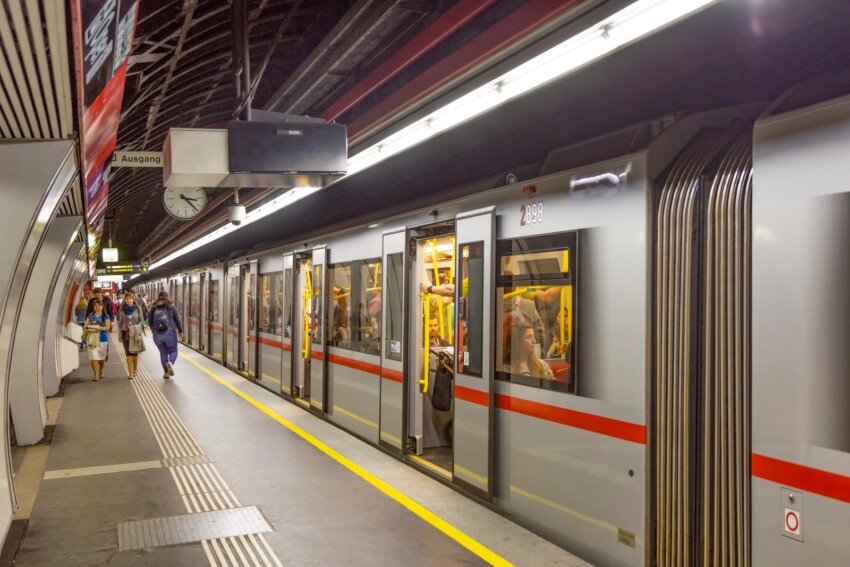
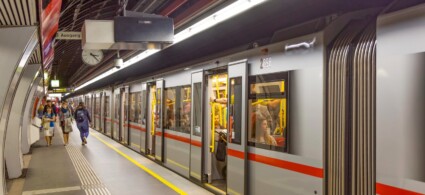
The underground (U-Bahn) is the backbone of Vienna’s public transport system and the fastest way to get around the city. With five lines identified by the colours and abbreviations U1, U2, U3, U4 and U6 (U5 is under construction), the metro covers over 83 kilometres with 109 strategically distributed stations.
The U1 line, recognisable by its red colour, traverses Vienna from north to south through the heart of the city. Stopping at Stephansplatz in the middle of the city centre next to St. Stephen’s Cathedral, this line also connects the Hauptbahnhof railway station with the northern residential districts. It is probably the line most frequently used by tourists.
The U2 line (purple) runs on a semicircular route that touches important interchanges and lively areas such as the Prater. This line has recently been extended and modernised, with stations equipped with the latest accessibility and safety technology.
The U3 line (orange) connects the western and eastern parts of the city, passing Stephansplatz and facilitating access to Schönbrunn Palace via the Zieglergasse stop with a change to the tram. This is a key line for reaching many tourist attractions.
The U4 line (green) partially follows the course of the river Wien and the Danube Canal, connecting important residential districts with the centre. Many of its stations retain the original Art Nouveau architecture designed by Otto Wagner and are themselves an architectural attraction.
The U6 line (brown) is partially elevated and offers panoramic views of the city. It connects the Westbahnhof station with the northern districts, passing through important commercial and residential areas. Some of its stations are masterpieces of Viennese modernist architecture.
The Vienna Metro operates daily from 5 a.m. until about midnight on weekdays. During peak hours, trains run every 2-4 minutes, ensuring an extremely frequent service that makes waiting virtually non-existent.
On Friday evenings, Saturday nights and before public holidays, the metro runs 24 hours a day, allowing you to enjoy Vienna’s nightlife without worrying about getting back to your hotel. During the night, frequencies are reduced to about 15 minutes between trains.
On weekends and daytime holidays, the service maintains regular frequencies every 5-10 minutes. During scheduled maintenance work, which is usually announced well in advance, some routes may be temporarily replaced by replacement buses, which are always clearly signposted.
Trams: the symbol of Vienna
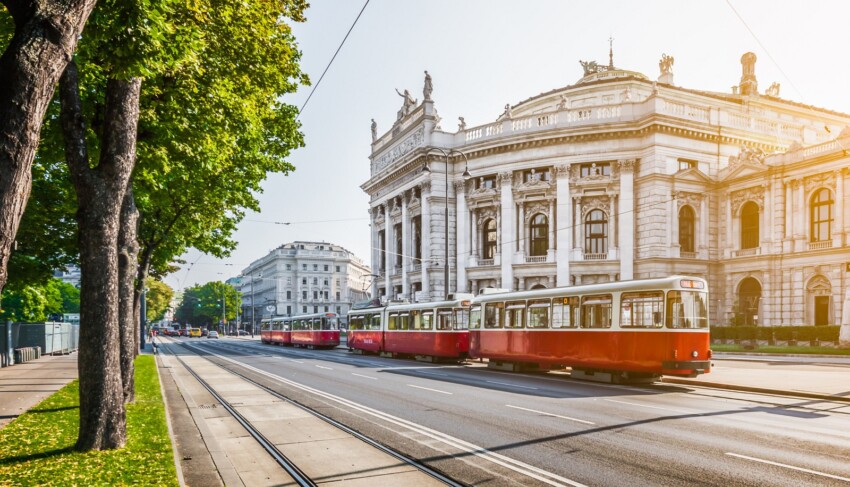
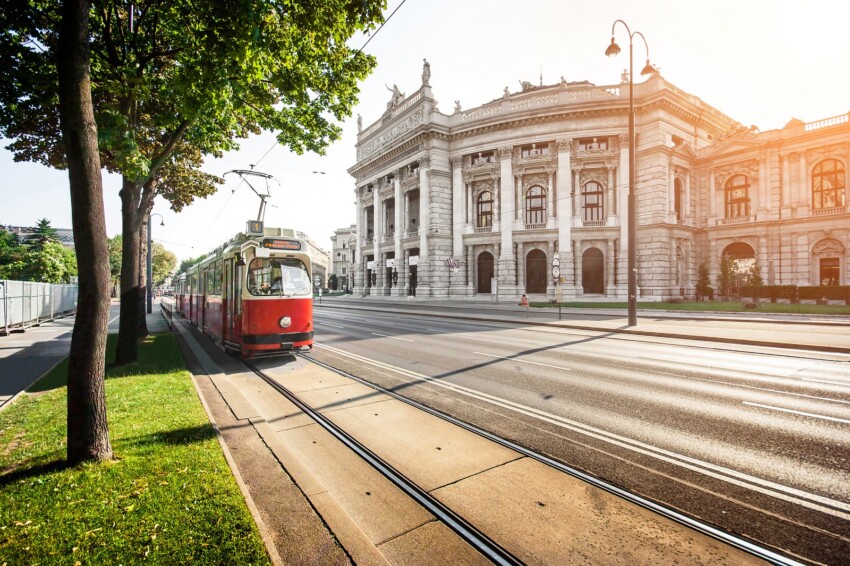
Trams (Straßenbahn) are an icon of Vienna and constitute the sixth largest tram network in the world, with 225 kilometres of track and 29 lines serving more than 1,000 stops. Travelling by tram allows you to see the city from a privileged perspective, passing through historic districts and elegant streets.
The most touristy lines are the 1 and 2, which run along the famous Ring, the circular boulevard that runs where the city’s medieval walls once stood. These lines pass the most iconic monuments such as the Hofburg Imperial Palace, the Rathaus, the Burgtheater and the State Opera.
The D tram is particularly useful for reaching Belvedere Castle, one of the city’s most beautiful Baroque palaces. Other important trams connect residential areas with peripheral attractions such as the Prater complex or the district markets.
Viennese trams are mainly modern low-floor vehicles, easily accessible even with buggies or wheelchairs. Some historical trams are still used on specific lines, offering a nostalgic experience of public transport from days gone by. During the Christmas holidays, a characteristic thematically decorated tram also runs.
Tram frequency and timetable
Trams generally operate from 5 a.m. until 11.30 p.m. to midnight, with frequencies varying from 5-10 minutes during the day to 10-15 minutes in the evening hours. The main lines maintain shorter intervals throughout the day.
At weekends, daytime service is regular, while at night on Fridays and Saturdays trams are replaced by night buses following similar routes. Detailed timetables are always displayed at the stops, and digital displays indicate the arrival of the next vehicles in real time.
Tourist buses
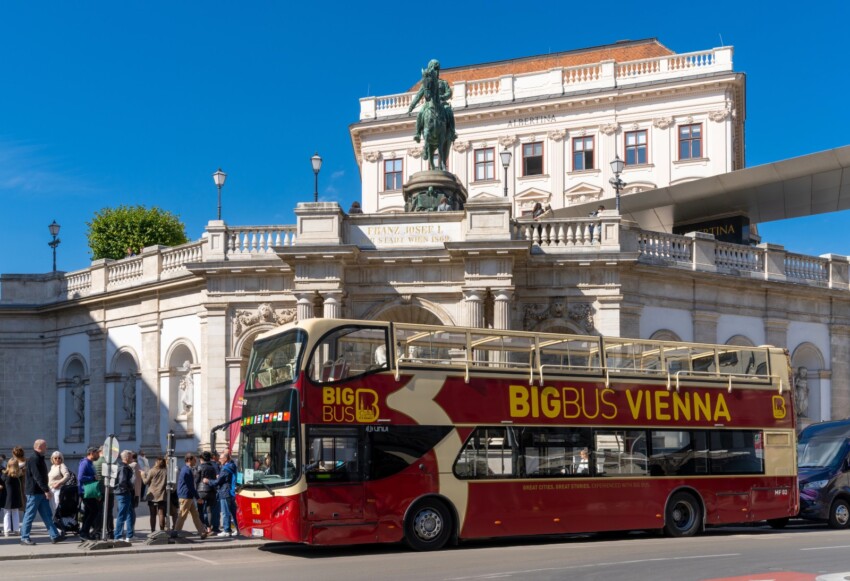
You can also find hop on hop off tourist buses in Vienna, a solution that combines some of the advantages of public transport with the convenience of private transport.
Usually operated by private companies, they are affordably priced, much cheaper than a taxi, but are easier to use than buses, trams and metro because they follow a set route with stops at major tourist attractions. You don’t have to wonder which bus or metro to take to get to the Imperial Palace: the sightseeing bus takes you right there!
Another advantage of opting for the hop on hop off bus is the freedom to hop on and off as many times as you like during the validity of your ticket; in addition, during your tour of the city, the audio guide will give you lots of historical information and interesting facts about the city. All for the price of a single ticket!
Buses complete the transport network by reaching areas not served by metro or tram. With around 130 daytime lines, buses are essential for extensive connections in residential neighbourhoods and for reaching specific destinations.
Bus line numbers are easily distinguishable: city lines have simple numbers (such as 13A, 48A), while express buses connecting different areas have numbers beginning with ‘2’ or ‘3’. The buses are all modern, air-conditioned and equipped with access platforms to facilitate boarding for people with reduced mobility.
Night buses (Nightline) guarantee mobility even during the hours when the metro and trams do not operate. Identifiable by the letter ‘N’ followed by a number, they all depart from central points such as Schwedenplatz and follow radial routes to the suburbs, passing about every 30 minutes.
At weekends, when the metro runs all night, night buses still maintain service to provide direct connections to areas not served by the metro. Standard tickets are also valid on the night buses, with no extra charge.
Stops on demand
Many bus stops, especially in outlying areas or during the evening hours, operate on demand: you must press the stop button if you wish to get off, otherwise the bus will continue without stopping. At outside stops, raise your hand to signal to the driver that you wish to board.
Suburban S-Bahn trains
The S-Bahn (Schnellbahn) network is the suburban train system that connects the centre of Vienna with the suburbs and neighbouring municipalities. With lines identified by the letter ‘S’ followed by a number, these fast trains are particularly useful for reaching destinations outside the centre or for quick connections between different parts of the city.
Within Vienna’s city limits, standard Wiener Linien tickets are also valid on the S-Bahn, making the system fully integrated. If you travel beyond the city limits, you will have to purchase additional tickets for the suburban areas.
The S7 line is particularly important for tourists because it directly connects Vienna-Schwechat Airport with the city centre, stopping at the Wien Mitte station and continuing northwards. The journey from the airport to the centre takes about 25 minutes and is much cheaper than the CAT (City Airport Train) express train.
The S-Bahn trains operate from early in the morning until late in the evening, with frequencies ranging from 10 to 30 minutes depending on the line and time of day. Being real trains, they offer more comfort and speed than buses and trams for longer distances.
Tickets, subscriptions and fares
Vienna’s fare system is simple and integrated: a single ticket is valid on the underground, trams, buses and S-Bahn within the urban area. Prices are regulated and all tickets are managed by Wiener Linien.
Single ticket
The single ticket (Einzelfahrschein) costs EUR 2.40 and allows you to make a complete journey to a destination within Vienna, with all necessary changes, for a maximum duration of 80 minutes after validation. You may not interrupt the journey with breaks or stops: once you get off, the ticket is no longer valid.
You can change means of transport as many times as necessary (from metro to tram, from tram to bus, etc.) as long as you always continue in the same general direction to your destination. The single ticket is only cheap for 1-2 occasional trips; if you plan to use the means of transport several times, season tickets are much cheaper.
Children between 6 and 15 years of age pay EUR 1.20 for the reduced single ticket. Children under 6 years always travel free of charge without a ticket.
24-hour ticket
The 24-hour ticket (24-Stunden-Wien) costs 8.00 euro and allows unlimited travel on all public transport for 24 consecutive hours after validation. This ticket becomes cheap from the third journey and is the ideal choice if you visit Vienna for a whole day.
You can get on and off the means of transport as often as you wish, with no restrictions on route or direction. The ticket is perfect for exploring the city without having to worry about validating a new ticket each time you move.
48- and 72-hour tickets
The 48-hour ticket costs €14.10 and the 72-hour ticket costs €17.10, both offering unlimited travel for 2 or 3 consecutive days after validation. These passes represent the best value for money for multi-day stays.
At 17.10 euros for three days, you essentially pay less than 6 euros per day for unlimited travel throughout Vienna. Considering that a single ticket costs EUR 2.40, you only need to make three trips per day to more than amortise the expense of a day or multi-day pass.
Weekly ticket
The weekly ticket (Wochenkarte) costs 19.70 euros for the non-transferable digital version and 22.60 euros for the transferable paper version. It is valid for seven consecutive calendar days after validation.
This season ticket is particularly convenient for longer stays and can be shared between several people if you buy the transferable paper version. For example, two friends can use the same weekly ticket in turn, as long as only one person uses it at a time.
Where to buy tickets
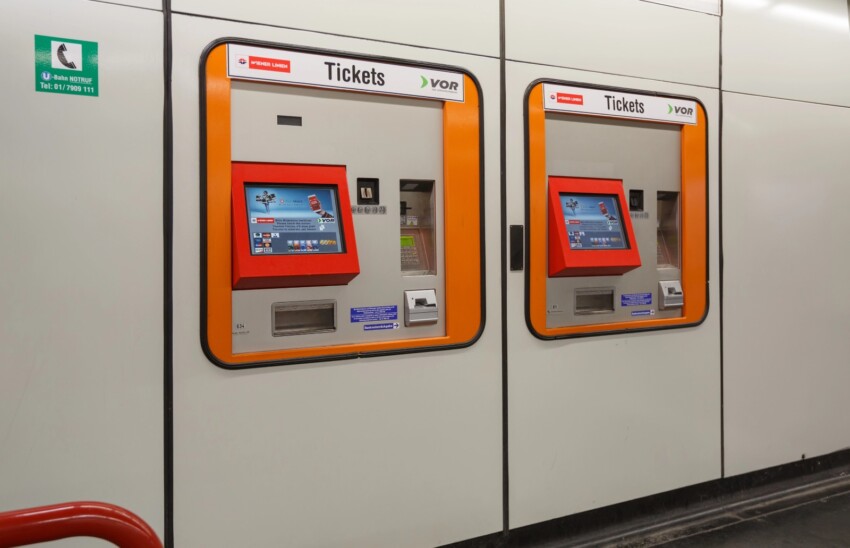
Tickets can be purchased from various authorised retailers. Vending machines can be found in all metro stations, at major tram stops and interchange points. They accept coins, banknotes and credit/debit cards, with interfaces available in several languages.
Tobacconists (Tabak-Trafik) identified by the blue ‘WL’ logo sell all types of tickets. This method is convenient if you are staying in areas not directly served by the metro. Many kiosks also sell transport tickets.
The Wiener Linien mobile app allows you to buy digital tickets directly on your smartphone, without having to search for retailers or machines. The digital tickets are immediately active and you can show them in case of control. The app is free of charge and available for iOS and Android.
On trams and buses it is possible to buy single tickets directly from the driver, but the price increases to EUR 2.60 compared to EUR 2.40 for the machines. This is an option to use only in emergencies when you have no other options.
Validation of tickets
All paper tickets must be validated before starting the journey. In underground stations, blue ticket validators are located at the entrance, before the stairs or escalators leading to the platforms. Insert the ticket with the printed side up until you hear the stamping ‘beep’.
On trams and buses, stamping machines are located near the entrance doors. Remember to validate your ticket immediately after boarding. Failure to validate is considered equivalent to travelling without a ticket.
Digital tickets purchased via app or tourist cards with transport included do not require validation: they are already active from the date and time selected during purchase or first use.
Vienna City Card and tourist passes
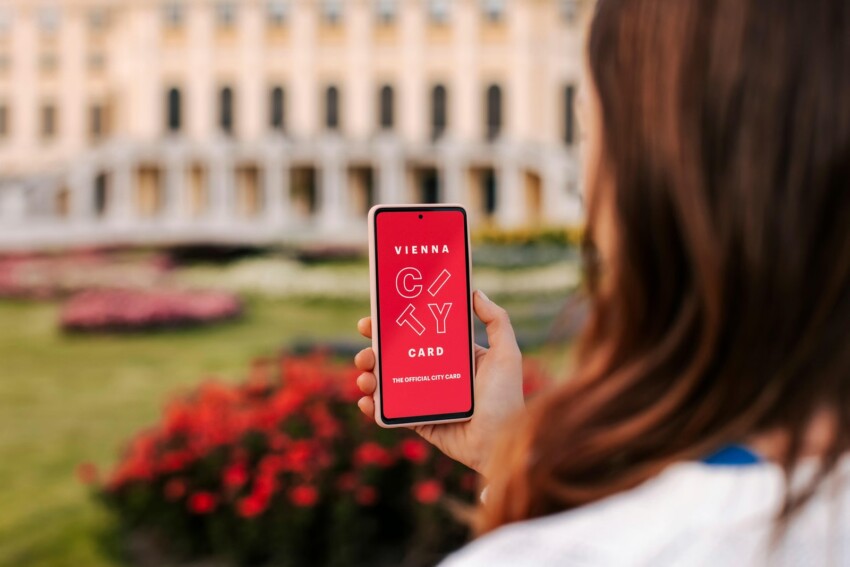
The Vienna City Card is a tourist card that combines unlimited public transport with discounts at over 200 attractions, museums, restaurants and shops. It is available in 24-, 48-, 72-hour or 7-day versions, with prices starting at around EUR 17 for 24 hours.
The card includes unlimited travel on the entire Wiener Linien network and offers reductions of generally 15-25% on admission to major museums and attractions. An interesting advantage is that one child up to the age of 15 travels free with each adult card.
Carefully consider whether the Vienna City Card is worthwhile for your itinerary: if you visit a lot of ticketed attractions, the savings on admissions can offset the slightly higher cost compared to a simple transport ticket. For those who prefer to explore the city without entering many museums, the standard 48- or 72-hour ticket is cheaper.
The Vienna Pass is an alternative that includes free entry to over 70 attractions but requires separate purchase of transport tickets. Always compare the different options according to your specific sightseeing programme.
Children up to 6 years of age always travel free of charge without a ticket or ID. Children between the ages of 6 and 15 travel free of charge every Sunday, on public holidays and during the Viennese school holidays. On these special days they must, however, carry proof of age.
People over 65 benefit from reduced single tickets at €1.50 instead of €2.40. This reduction only applies to single tickets and not to day or multi-day passes.
Dogs may travel on public transport with a muzzle and leash, subject to purchase of a reduced ticket costing €1.20. Guide dogs for the blind always travel free of charge without the need for a muzzle.
Taxis and alternative services
Taxis are widely available in Vienna but significantly more expensive than public transport. They stop at train stations, major hotels and central tourist areas, or you can call them by phone or app.
Fares are regulated with a mandatory meter: the basic fare is about EUR 3.80, plus EUR 1.40-1.50 per kilometre during the day. A surcharge applies at night (23:00-6:00), on weekends and on public holidays. A typical ride in the city centre costs 10-15 euro.
The apps Uber and Bolt operate regularly in Vienna, often with competitive rates compared to traditional taxis. These platforms show the estimated price before booking, avoiding surprises. Payment is made automatically via a credit card registered in the app.
For those who prefer to get around by bike, Vienna offers the Citybike service with over 120 bike-sharing stations spread throughout the city. The first hour is free, making it ideal for short trips. Vienna has over 1,400 kilometres of cycle paths, many of which run through the city centre.
From the airport to the city centre
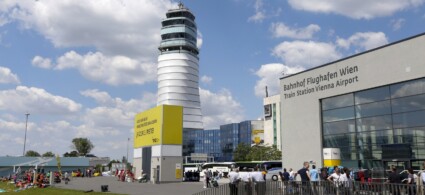
Vienna-Schwechat Airport is about 18 kilometres from the city centre and offers several connection options with varying costs and times.
The S7 train of the S-Bahn is the cheapest option: it costs only EUR 2.40 with a normal single public transport ticket if purchased in advance, or EUR 4.40 if purchased directly from the airport. The journey to Wien Mitte station takes 25 minutes, with departures approximately every 30 minutes.
The City Airport Train (CAT) is an express train that connects the airport to Wien Mitte in just 16 minutes, with no stops in between. It costs about 12 euro one-way and 21 euro return. It offers more comfort and speed but is significantly more expensive than the S-Bahn.
Vienna Airport Lines buses connect the airport with different parts of the city in 20-45 minutes depending on the destination. They cost about 9 euros one way. They are convenient if your hotel is located along the route of one of the lines.
Taxis from the airport to the city centre cost fixed rates of around 35-40 euro for destinations in the centre. Some companies offer pre-arranged fares via online booking. Journey time varies between 20 and 40 minutes depending on traffic.
How to save on transport and entrance fees
City Card allow you to save on public transport and / or on the entrances to the main tourist attractions.


 Hotel
Hotel  Budget accommodations
  Apartments
  Family Hotel
  Luxury Hotel