Das Alfred
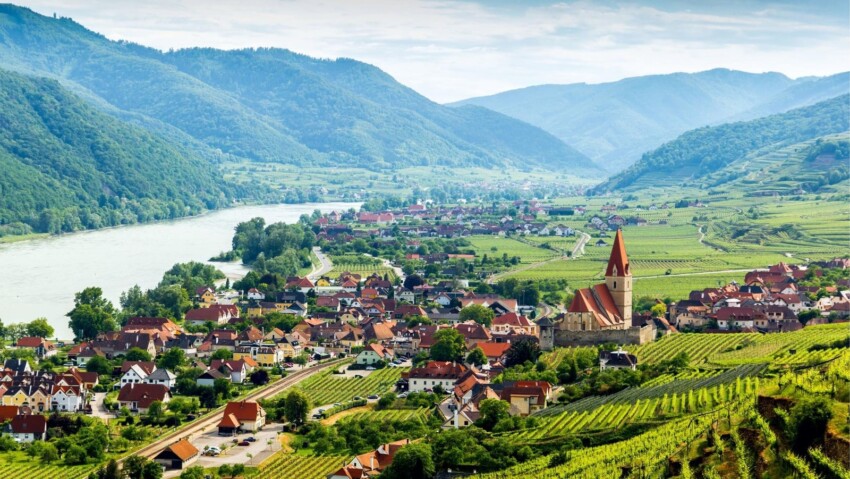
Alpine passes, mountains, rivers, lakes and many caves, but also medieval towns, castles and Habsburg palaces: this is what a visitor to Lower Austria, or Niederösterreich, the north-eastern region of the country, which surrounds the Land of Vienna like an embrace and contains part of its periphery, should expect.
Its capital city is St. Pölten, while other important cities worth visiting are Amstetten, Krems an der Donau and Wiener Neustadt. But Lower Austria is full of monasteries, castles and palaces, and of course beautiful landscapes, a constant throughout the country. Visit it with a rental car for a complete on-the-road tour, but also take the Semmering Railway, which runs from Vienna to the southern part of the region passing through magical landscapes with 16 viaducts, 100 bridges and 15 tunnels: this 20th century engineering marvel is a UNESCO World Heritage Site.
You can study an itinerary to discover the baroque monasteries of Melk and Göttweig, be inspired by the castles of Rosenburg, Schallaburg, and Aggstein, or the dreamy atmosphere of Schloss Hof, former residence of Prince Eugene of Savoy. A visit to Carnuntum, an ancient Roman city with a population of 50,000 during the 1st century AD, is also interesting. And of course, the wine landscapes, gentle hills dotted with wine cellars and farms, are not to be missed.
Despite its name, Lower Austria is located in the north-east of the country. It entirely surrounds Vienna (but does not include it, as the Austrian capital is part of its own region) and borders Slovakia to the east and the Czech Republic to the north. The other neighbouring Austrian regions, apart from the Land of Vienna, are Upper Austria, Styria and Burgenland.
With an area of more than 19,000 square kilometres, Lower Austria is the largest region in the country and is divided into four zones with distinct geographical characteristics: the Weinviertel, the Waldviertel , the Mostviertel and the Industrievertel, whose names curiously translate as ‘wine district’, ‘forest district’, ‘must district’ and ‘industry district’.
Lower Austria’s climate is oceanic, with warm summers and cold winters. Precipitation follows that of Vienna, with snowfall in the winter months and rainfall never too rare throughout the year.
It may not be the most popular region for tourists, but Lower Austria can satisfy the needs of any visitor. From historical towns to medieval fortresses, from enchanting landscapes to rural villages, here are the most beautiful things to see in the region.
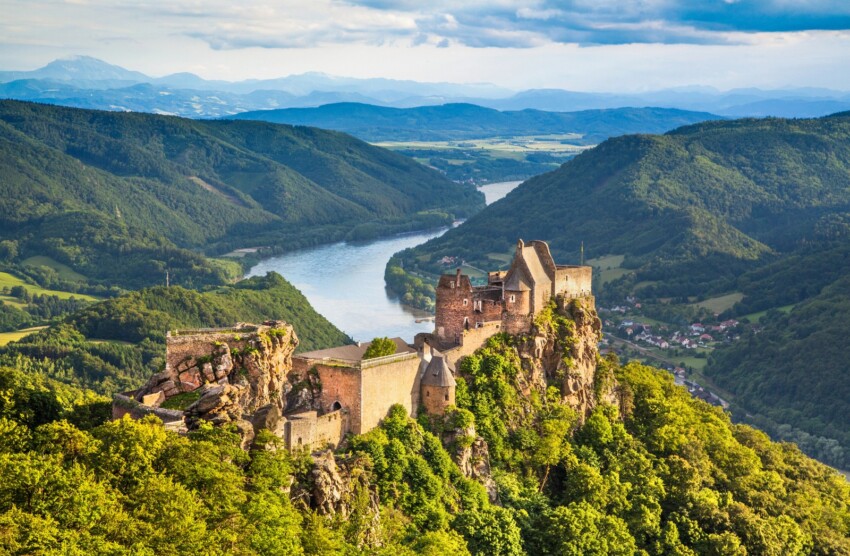
The Wachau Valley represents one of Europe’s most extraordinary cultural landscapes, a 36-kilometre-long area along the Danube between Melk and Krems where the hand of man has created a perfect harmony with nature over two millennia. This UNESCO World Heritage Site since 2000 preserves a unique ecosystem where wine terraces built with drystone walls climb steep slopes, while the Danube flows placidly between medieval castles and villages that seem straight out of a fairy tale.
The particularly mild climate of the valley, protected from the cold northern winds by the surrounding hills, has favoured viticulture since Roman times. The indigenous varieties Grüner Veltliner and Riesling reach world-class levels here, while the famous Wachauer Marille (Wachau apricot) is so prized that it is protected by a specific quality label. The golden fruits ripen on south-facing terraces and become the protagonists of unique culinary delicacies such as Marillenknödel (apricot dumplings).
The picturesque villages of Wachau retain their medieval charm: Dürnstein, with the ruins of the castle where Richard the Lionheart was imprisoned in 1192, Spitz famous for its steeply terraced Tausendeimerberg vineyard, and Weißenkirchen surrounded by terraced vineyards and Gothic churches. Boating on the Danube offers unique perspectives on this landscape, while the Heuriger (new wine taverns) allow visitors to taste local products in authentic atmospheres that perpetuate centuries-old traditions.
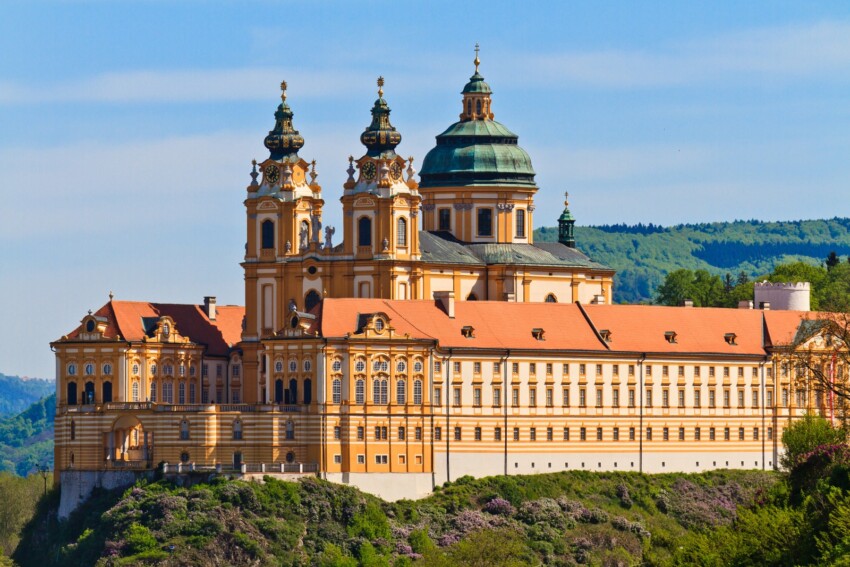
Among the most beautiful things to see in Lower Austria is the Benedictine Abbey of Melk, a UNESCO World Heritage Site. Dating back to the year 1000, and later renovated in Baroque style, it is located along the Danube on a rocky outcrop, just a stone’s throw from what is now the lively town of Melk.
A visit from the outside and inside is a must: famous is its library, according to some used by Umberto Eco as inspiration for his ‘The Name of the Rose’. With over 100,000 volumes and splendid frescoes by Paul Troger, it was one of the most important and famous libraries of the Middle Ages. From the library, a spiral staircase leads up to the Stifskirche, a beautiful frescoed church. There is also a museum within the complex, with modern installations.
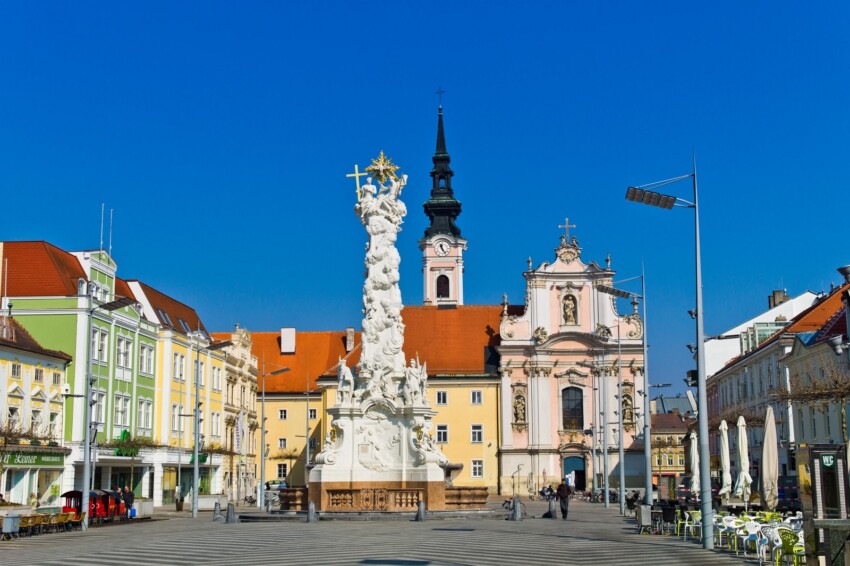
Sankt Pölten, the capital of Lower Austria since 1986 with its 55,000 inhabitants, is a fascinating urban laboratory where two thousand years of history merge with the most contemporary architecture. Founded by the Romans in the 2nd century as Aelium Cetium, the city was granted civic rights in 1159, boasting the oldest documented municipal charter in Austria. Today’s historic centre is the result of the grandiose Baroque transformation that took place after 1689, when architect Jakob Prandtauer moved into the town, triggering a building boom that gave it its current appearance.
The Cathedral of the Assumption (Kathedralkirche Maria Himmelfahrt) dominates the city with its majestic Baroque façade and richly frescoed interior by Bartolomeo Altomonte. The Rathausplatz, the heart of the old town, is surrounded by Baroque palaces and dominated by the Trinity Column from 1782, while the 16th-century Town Hall flaunts an elegant Baroque façade topped by an octagonal tower with a modern 48-bell carillon installed in 2022.
The modern government quarter, designed after its designation as regional capital, houses the futuristic ‘Landtagsschiff’ (Parliament Ship), a bold 180-metre-long glass and steel building. The Festspielhaus, home of theLower Austria Tonkünstler Orchestra, is one of the most technologically advanced theatres in Europe, while the 77-metre-high Klangturm (Sound Tower) offers spectacular views of the region. The Lower Austria Museum documents the region’s natural and cultural history through state-of-the-art multimedia installations.
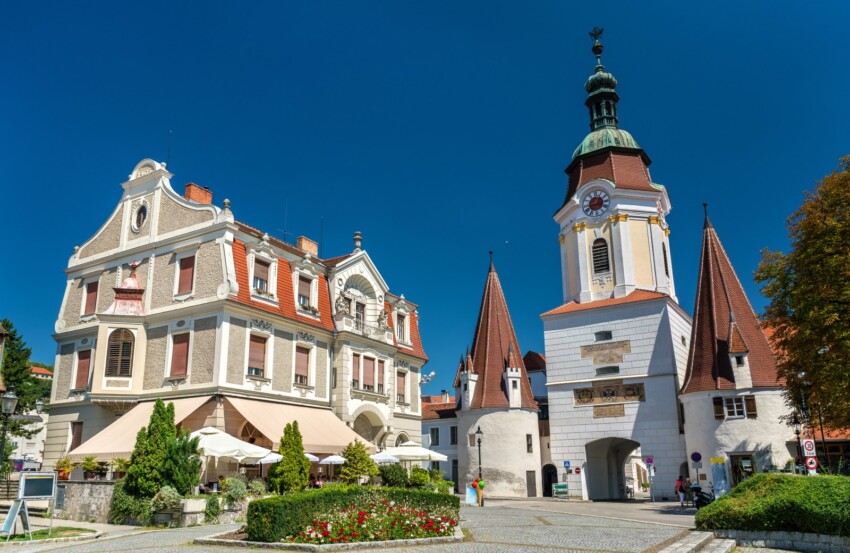
The town of Krems an der Donau, which simply means ‘Krems on the Danube’, has about 25,000 inhabitants, making it the fifth most populous town in Lower Austria. Situated at the confluence of the Danube and the Krems River in the Waldviertel region, Krems was as large as Vienna in the 11th century.
Today it is a pleasant tourist destination in Lower Austria, well worth a visit. In the old town , don’t miss the Steiner Tor, an old city gate dating back to 1480, the magnificent columned statue of the Dreifaltigkeitssäule and the Rathaus, the town hall.
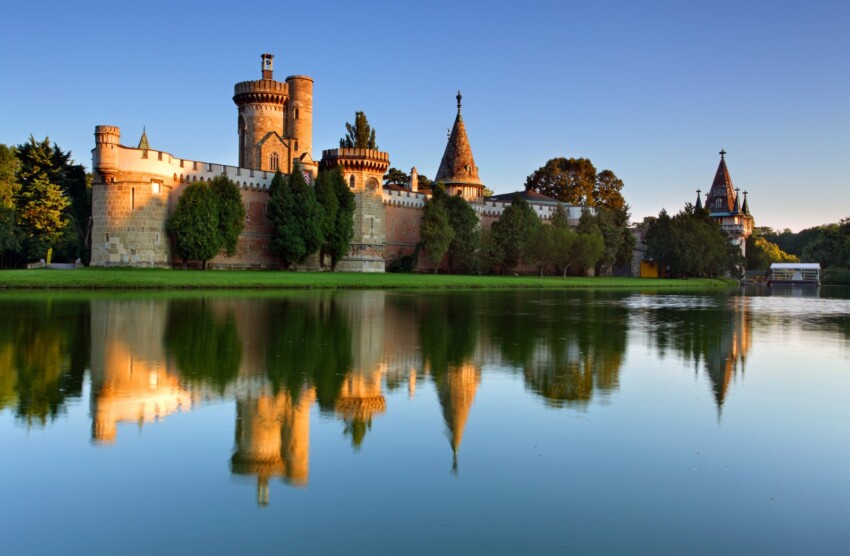
The Schlosspark Laxenburg is a huge park surrounding the Franzensburg, a magnificent medieval-inspired castle built on an artificial island so that it looks as if it were surrounded by a moat. When visiting Schlosspark Laxenburg, you will be immersed in nature and culture, in a truly unique mix.
The entire site is located about 15 kilometres south of Vienna, near the village of Laxenburg. The park, which dates back to the 18th century, covers an area of 280 hectares and is landscaped down to the last detail, thanks to the efforts of the Habsburgs, in particular Empress Maria Theresia and her grandson, Emperor Franz.
Franzensburg, meaning ‘Franz’s Castle’, was completed in 1835, and today its rooms are part of the castle museum, while in Sissi’s time it was the place where the famous empress spent her honeymoon.
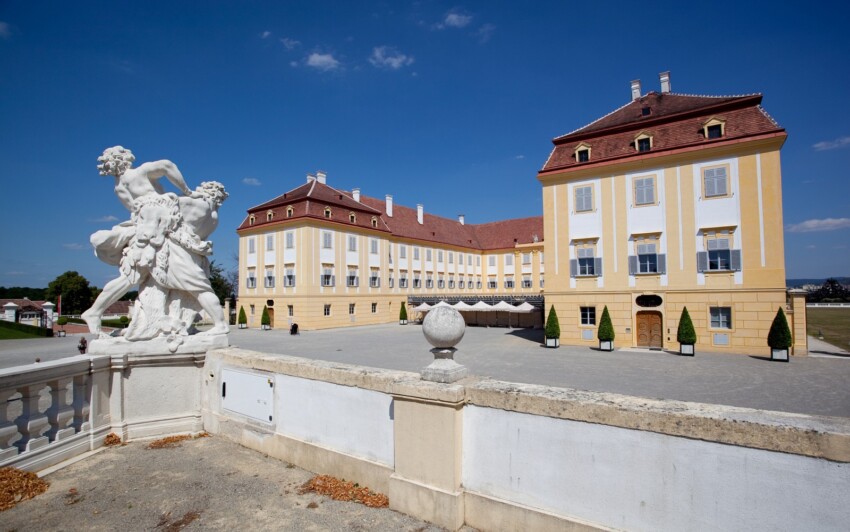
On the Marchfeld plain, bordered by the two rivers Danube and Morava, stands Schloss Hof, a splendid palace dating back to 1720, the former hunting lodge of Prince Eugene of Savoy. The entire complex includes the palace, the huge garden surrounding it and the farm, all designed by the same architect who built the Vienna Belvedere, Johann Lucas von Hildebrandt.
Schloss Hof reached the pinnacle of its history when it was purchased by the Habsburgs in the late 1700s and became a venue for celebrations and festivities. Recently renovated, it is well worth a visit to relive court life inside the flats, but above all to get lost wandering around the large garden with its terraces and flowerbeds.
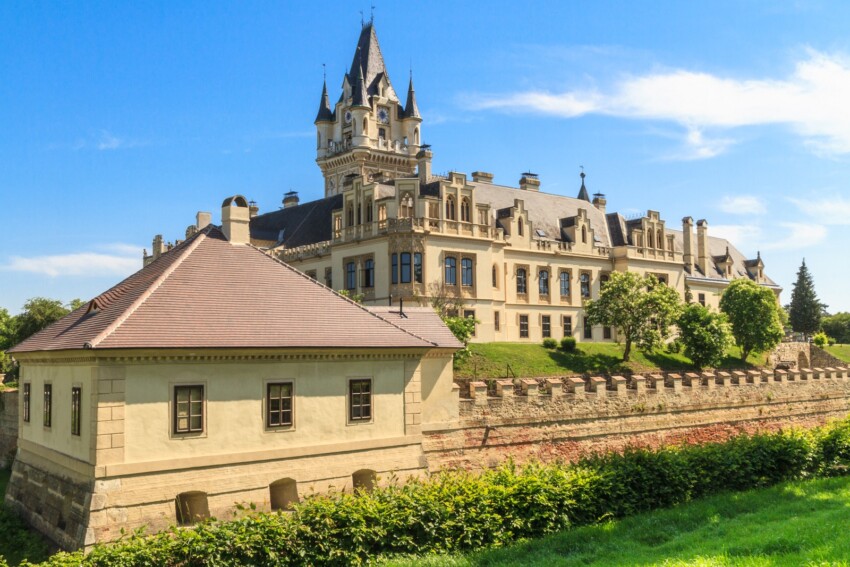
Grafenegg Castle is one of the most important exponents of Romanticism in Austria. Built in the 14th century and extended in the 19th century, it possesses Gothic, Baroque, Biedermeier and Neo-Gothic influences in a truly interesting mix of styles: towers, facades, staircases, arches and chapels can be admired in a single structure; a true symbol of Lower Austria and certainly one of the country’s most beautiful castles.
The 32-hectare castle park, dating back to the 18th century, deserves a special mention. An oasis of peace and tranquillity, interspersed with a series of modern works of art and a large pavilion dating back to the mid-18th century, now completely renovated, where events of all kinds are held, as well as weddings and private parties.
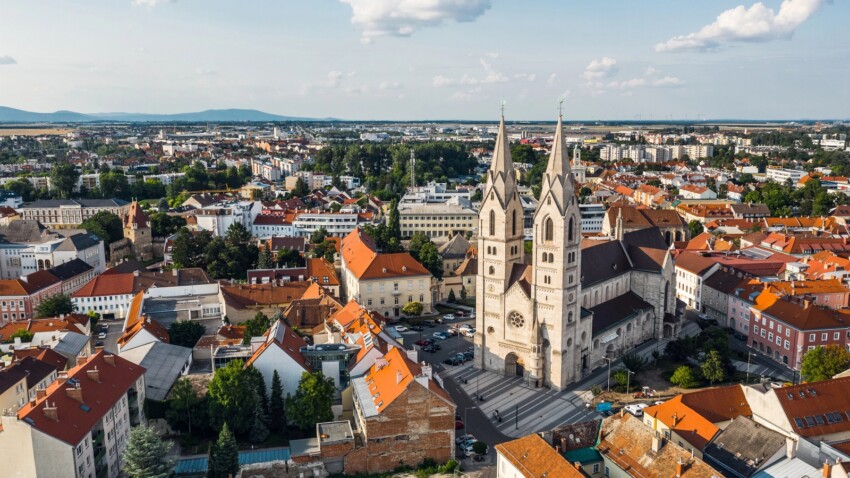
Wiener Neustadt, the ‘New Vienna’ founded in 1194 by Duke Leopold V of Babenberg with the ransom paid for the liberation of Richard the Lionheart, is one of the most historically rich cities in Lower Austria. Located 48 km south of Vienna, this city of 45,000 inhabitants is strategically located at the gateway to the Eastern Alps, along the ancient Amber Route that connected the Baltic to the Mediterranean.
The Hauptplatz, one of the most beautiful rectangular squares in medieval Austria at 133 x 53 metres, is dominated by the Mariensäule from 1678 and surrounded by Gothic and Renaissance palaces with characteristic arcades. The cathedral (Dom), built in Romanesque style in 1279 and later extended in Gothic forms, preserves one of the most beautiful Gothic choirs in Austria, while the 75-metre-high bell tower offers spectacular views over the Pannonian plain and the Alps.
The 13th-century ducal castle, residence of the last Babenbergs and later the Habsburgs, houses the prestigious Teresian Military Academy, founded by Empress Maria Theresa in 1751 and considered the oldest military academy in the world still in operation. The city is also home to the Museum St. Peter an der Sperr, which documents urban and regional history through valuable archaeological and artistic collections.
In the following map you can see the location of the main places of interest mentioned in this article.
Lower Austria is ideally visited from April to October, when the mild climate allows you to best appreciate the river landscapes and blossoming vineyards. The grape harvest period (September-October) is particularly impressive, with ‘Weinherbst’ (wine autumn) celebrations and wine tastings in the Heuriger.
The train is the ideal way to reach the main cities: Sankt Pölten and Krems are connected to Vienna by regional services every 30 minutes, whilebus 601 conveniently connects Vienna Airport with the main destinations in the region. To explore the Wachau region, we recommend renting a car, which allows you to reach the small villages and the most spectacular viewpoints.
For overnight stays, we recommend you consult our specific guides on where to stay in Austria to find accommodation to suit every budget, from historical hotels in Baden to tourist farms in the Waldviertel. The Danube cycle path, which crosses the region for more than 300 km, is an environmentally friendly and scenic alternative to discover Lower Austria’s treasures at a leisurely pace, stopping in Heuriger to taste local products and admire landscapes that have inspired generations of artists.
 Hotel
Hotel  Budget accommodations
  Apartments
  Family Hotel
  Luxury Hotel